

NEWSLETTER | EDITION 10
What Changes from Year 10 to VCE?
Independence | Application | Problem-solving | Feedback
Moving from Year 10 into VCE is more than simply studying harder content. Students are expected to become more independent, apply their knowledge in unfamiliar situations, manage a greater workload and take greater responsibility for their own learning.
Why Victorian Curriculum 2.0 matters
From 2026, Victorian government schools are required to fully implement the Victorian Curriculum F-10 Version 2.0 across most learning areas, including Science. Mathematics Version 2.0 was already fully implemented from 2025. These changes, introduced through VCAA and Department of Education implementation requirements, place greater emphasis on students being able to apply knowledge, reason, problem-solve and respond to unfamiliar situations.
Students are increasingly expected to interpret information, justify their thinking, analyse evidence and select an appropriate strategy when the answer is not immediately obvious.
For students approaching VCE, this means success is about more than remembering what has been taught - it is about being able to use that knowledge.
KNOW
Build secure knowledge: vocabulary, facts, formulas and processes.
REASON
Explain how and why, justify choices and connect ideas.
APPLY
Use knowledge in practical, unfamiliar and multi-step situations.
The transition to VCE is therefore not only a jump in content. It is also a shift towards independence, reasoning and transfer of learning.
NEWSLETTER | EDITION 10 · What Changes from Year 10 to VCE?
1 Learning Is Becoming More Application-Based
A student might know a formula, definition or scientific concept - but can they use it when the question looks different from the examples they have practised?
In Mathematics
Students still need strong knowledge and fluency, but they are also expected to:
• solve non-routine and unfamiliar problems
• solve practical problems and use mathematical modelling
• select an appropriate strategy rather than being told which method to use
• explain and justify their mathematical thinking
In Science
At Years 9 and 10, students are increasingly expected to:
• analyse experimental data
• use scientific ideas to explain relationships and trends
• evaluate experimental methods and suggest practical improvements
• communicate evidence-based scientific explanations
| Routine question | Non-routine / unfamiliar question |
|---|---|
| "Use this formula to calculate ..." | "What mathematics should I use here?" |
| The method is familiar and the next step is clear. | The student must interpret the situation, choose a strategy and justify the approach. |
Why does this matter?
Routine questions build fluency. Unfamiliar questions show whether a student can transfer learning to a new situation. They help distinguish between being able to repeat a procedure and being able to apply understanding independently.
In Science, these inquiry skills also build an important foundation for the Key Science Skills students encounter in VCE Science subjects.
NEWSLETTER | EDITION 10 · What Changes from Year 10 to VCE?
2 Knowing the Content Is No Longer Enough
One of the biggest changes as students approach VCE is the difference between "I know this" and "I can use this".
Knowledge
LEVEL 1
Can I remember and understand it?
Definitions, formulas, facts and processes.
Reasoning
LEVEL 2
Can I use it and explain how or why?
Apply knowledge to a familiar situation and explain the reasoning.
Application
LEVEL 3
Can I work out what to do when the situation is unfamiliar?
Analyse, justify, evaluate and solve non-routine problems.
3 Questions Are Asking Students to Think
Differently
Students also need to pay close attention to command terms. These words are not interchangeable - they tell students what type of thinking and response is required.
Identify
Name or state the relevant information.
Describe
Provide characteristics or features.
Explain
Show how or why something occurs.
Compare
Identify relevant similarities and differences.
Analyse
Break information into parts and examine relationships.
Evaluate
Consider evidence or factors and make a judgement.
A common assessment trap
A student can understand the content but still lose marks because they answered a different question from the one that was asked. Learning to recognise command terms is an important part of preparing for VCE.
NEWSLETTER | EDITION 10 · What Changes from Year 10 to VCE?
4 More Independence
Another significant change is the level of responsibility given to students.
In Year 10, teachers may provide regular reminders about homework, assessments and deadlines. As students move into VCE, they are increasingly expected to take responsibility for their own progress.
Track assessments
Know SACs, coursework and major deadlines before they become urgent.
Catch up
Recover missed learning after an absence without waiting to be chased.
Organise revision
Plan regular revision rather than relying on last-minute study.
Find the gap
Identify what is not understood and seek targeted help.
Use feedback
Act on teacher comments and patterns in lost marks.
Manage the whole program
Balance multiple subjects, commitments, sleep and recovery.
Start now
Use a calendar, planner or digital system to keep track of important dates. The goal is simple: know what is coming up before it becomes urgent.
VCE students do not need to become perfectly organised overnight. The goal is to gradually rely less on reminders and become more responsible for planning, catching up and asking for help.
NEWSLETTER | EDITION 10 · What Changes from Year 10 to VCE?
5 Active Study, Feedback and Error Logging
Studying for VCE should not simply mean spending more time studying. The way students study matters.
A student who regularly practises, checks their understanding and reflects on mistakes will usually be better prepared than someone who spends hours rereading notes before an assessment.
LEARN -> PRACTISE -> CHECK -> CORRECT -> REFLECT ->
TRY AGAIN
An error log turns feedback into a repeatable improvement process. Instead of looking at a mark and moving on, students record where marks were lost and identify why.
1. Question
2. My answer
3. Model answer
4. Reflection
Record the exact question.
Keep the original response.
Compare it with a full-mark response.
Explain why the mark was lost and what should change next time.
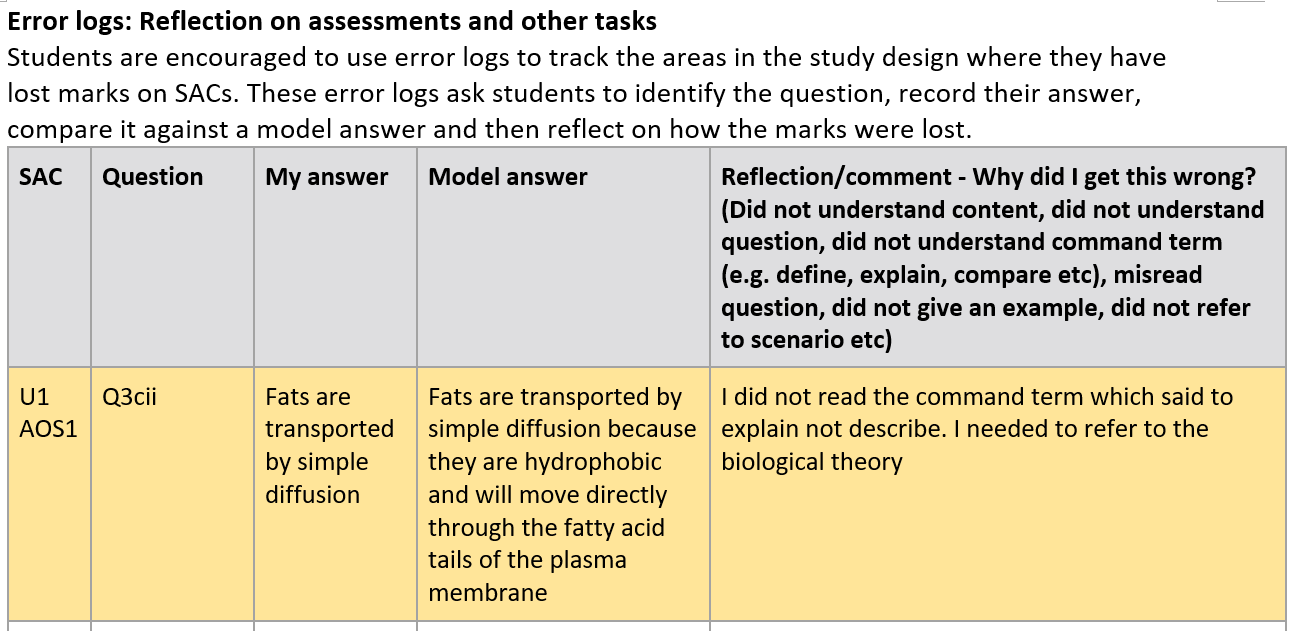
Example of an error log: the student compares their response with a model answer and records the specific reason the mark was lost.
A useful reflection should identify
• Did I misunderstand the content?
• Did I misread or misunderstand the question?
• Did I respond to the wrong command term?
• Did I fail to use the scenario, evidence, example, units or working?
• What should I do differently if I see a similar question again?
Do not just record the mark. Record the lesson from the mistake.
NEWSLETTER | EDITION 10 · What Changes from Year 10 to VCE?
6 Different Subjects Require Different Study Skills
There is no single study method that works equally well for every subject.
Mathematics
• practise questions regularly
• correct errors and develop fluency
• attempt unfamiliar and non-routine problems
• explain mathematical reasoning
• solve without relying on worked examples
Science
• understand concepts before memorising wording
• apply concepts to unfamiliar scenarios
• interpret graphs and experimental data
• evaluate investigations and suggest improvements
• use precise scientific terminology
Psychology & Biology
• use accurate terminology
• use active recall and spaced revision
• apply concepts to scenarios
• interpret research and evidence
• answer according to command terms
English
• read consistently
• annotate and develop ideas
• build vocabulary and expression
• practise analytical writing
• respond deliberately to feedback
Good study is active - not just rereading.
Students should repeatedly retrieve, apply, check and improve their knowledge. The goal is to become more independent each time they meet a similar problem.
A useful question after every study session
"Could I now answer a similar question without the
worked example, notes or teacher beside me?"
NEWSLETTER | EDITION 10 · What Changes from Year 10 to VCE?
Are You Ready for VCE?
Before entering Year 11, ask yourself:
[ ] Can I keep track of my own deadlines?
[ ] Can I complete work without being constantly reminded?
[ ] Do I revise throughout a topic rather than only before a test?
[ ] Can I apply what I know to a question I have not seen before?
[ ] Can I explain my reasoning rather than just give an answer?
[ ] Do I go back and correct my mistakes?
[ ] Can I identify what I do not understand?
[ ] Do I ask for help early?
[ ] Can I manage several subjects at the same time?
[ ] Can I catch up independently if I miss a lesson?
You do not need to answer yes to every question yet. These are skills that can be developed.
Final advice
The move from Year 10 into VCE is not simply a jump in the amount of content students need to learn. Students are increasingly expected to know the content, explain their reasoning and apply what they know in unfamiliar situations.
Victorian Curriculum F-10 Version 2.0 reinforces reasoning, problem-solving and application alongside strong foundational knowledge. Developing these habits before VCE can make the transition much smoother.
Students should keep asking themselves: