

NEWSLETTER | EDITION 2
VCE Results Explained
Study scores, SACs, moderation and scaling
For many students and parents, VCE results can feel confusing. Students often receive SAC marks throughout the year, then later receive study scores, scaled scores and an ATAR. These numbers are connected, but they are not the same.
This edition explains the journey from school-based assessment to final results, so students can focus on what they can control: consistent preparation, feedback, improvement and exam readiness.
The VCE results journey
SACs
School-based evidence of performance
Moderation
Places school assessment on a common scale
Study score
Relative performance in one Unit 3/4 study
Scaling
Adjusts study scores for ATAR calculation
1 What is a study score?
A VCE study score is a score out of 50 that shows how a student performed in a Unit 3/4 subject compared with other students who completed the same subject.
It is not a percentage. For example, a study score of 35 does not mean 35%. It reflects the student's overall position in that subject.
In large VCE studies, 30 is around the centre of the distribution. Scores above 40 are very strong results.
What contributes?
A study score is usually built from graded assessments, including school-based assessment and external exam performance.
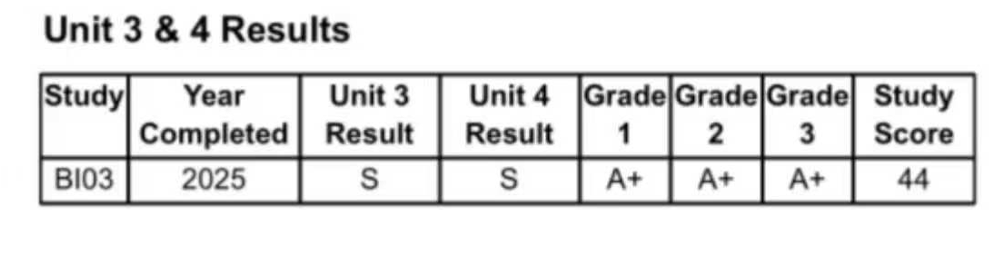
Example: graded assessments plus a study score.
2 Why do SACs and school-based assessments matter?
SACs matter because they contribute to school-based assessment and help students practise the skills, knowledge and exam-style thinking needed for the final examination.
Not just a mark
A raw SAC percentage is useful feedback, but it is not always the final number used in results.
Criteria matter
Students should read feedback and check how well their answers met the assessment criteria.
Exam links
SACs should help students identify what to improve before the final exam.
NEWSLETTER | EDITION 2 · VCE Results Explained
Understanding SAC weightings
A SAC result should be treated as feedback, not just a number. Each VCE subject has its own assessment structure, and the percentage contribution of school-based coursework and examinations can be different from subject to subject.
This is why students should check the VCAA Study Design for each subject. It shows how much school-assessed coursework and examinations contribute to the final result.
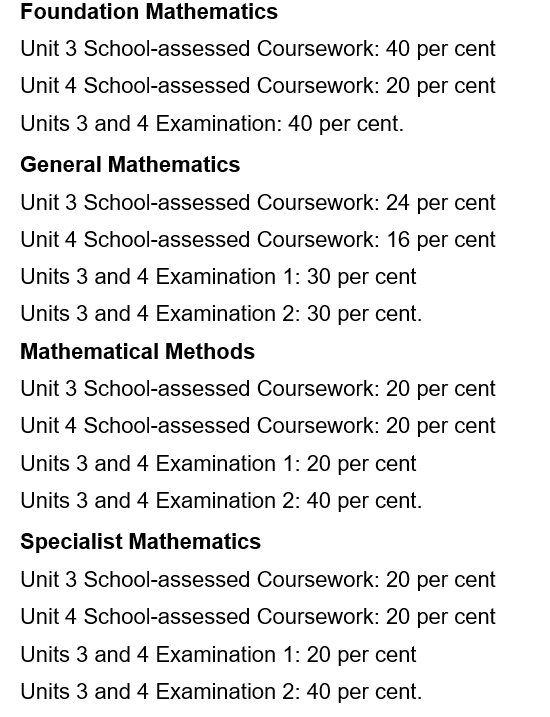
Visual example: Mathematics Study Design assessment weightings.
What students should notice
Different subjects can have different SAC and exam weightings.
One SAC may only be one part of the whole school-based assessment result.
A strong final result is built through repeated preparation, not one single task.
The final exam is important because it provides external evidence across the state.
A better way to think about SACs
Instead of asking only "what percentage did I get?", students should ask: What feedback did I receive? What type of questions did I lose marks on? What skills do I need to fix before the exam?
Focus areas after each SAC
understanding the criteria improving written responses using teacher feedback tracking recurring mistakes strengthening exam technique
NEWSLETTER | EDITION 2 · VCE Results Explained
3 What is moderation?
Moderation is one of the most misunderstood parts of VCE results. The key idea is fairness: students at different schools may complete different SACs, so school-based assessment marks need a way to be compared across the state.
Internal school moderation
Within a school, teachers may moderate assessment to help ensure marking is fair and consistent across classes. This may include common tasks, shared criteria, cross-marking and discussion of sample responses.
VCAA statistical moderation
Across the state, VCAA statistical moderation places school-based assessment results onto a common scale. This helps make school assessment comparable throughout the VCE system.
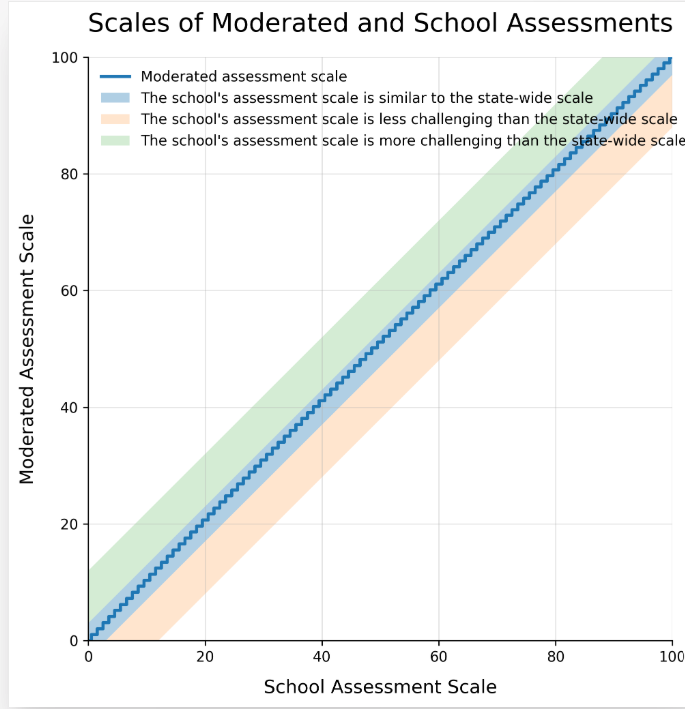
Visual tool: school assessment scale and moderated scale
How to read this
Teachers receive results information at the end of the year, including data that can help schools reflect on SAC difficulty. A graph like this shows whether a school assessment scale appears similar to, less challenging than, or more challenging than the broader state-wide scale.
Moderation is not designed to punish students.
It helps place school-based assessment onto a common scale.
The final exam provides external comparison across the state.
Some schools may intentionally set more challenging SACs to prepare students for exam-style demands.
Visual example: comparison of school assessment scale and moderated assessment scale.
NEWSLETTER | EDITION 2 · VCE Results Explained
4 What is scaling?
Scaling happens after VCAA study scores are produced. It is completed by VTAC and is used for ATAR calculation. Its purpose is to make study scores from different subjects more comparable.
Different subjects have different groups of students. Some subjects have very academically competitive cohorts, while others have a broader range of students. Scaling helps ensure students are not advantaged or disadvantaged simply because of the subjects they chose.
Visual tool: VTAC Scaling Report
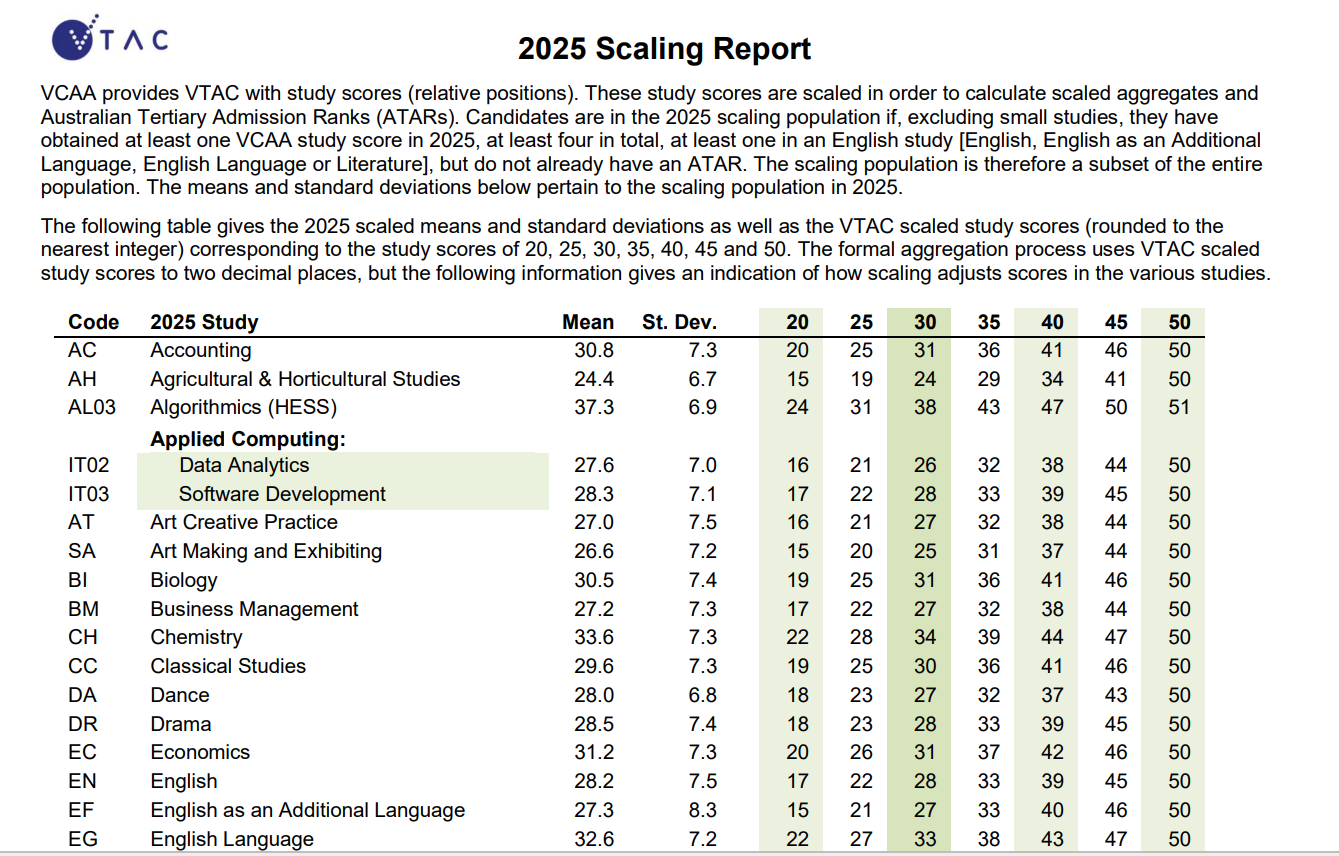
Visual example: VTAC publishes scaling information to show how study scores are adjusted for ATAR calculation.
Scaling does not judge a subject
A subject scaling up or down does not mean it is good, bad, easy or hard. It reflects the statistical process used to compare different subjects.
Performance still matters most
Strong performance still matters most. When students achieve very highly, a scale-down effect usually has much less impact than students expect.
A helpful way to explain it to students
Scaling is not a shortcut. A high-scaling subject does not guarantee success, and a scaling-down subject does not prevent success. The strongest strategy is still consistent learning and strong performance.
NEWSLETTER | EDITION 2 · VCE Results Explained
Moderation and scaling are not the same thing
This is one of the most common areas of confusion. Moderation and scaling both aim to make results fairer and more comparable, but they happen at different stages of the results process.
Moderation
Used by VCAA to adjust school-based assessment results so they can be compared fairly across schools. It applies to school-based assessment, not to choosing between subjects.
Scaling
Used by VTAC after study scores are produced. It adjusts study scores so different VCE subjects can be compared for ATAR calculation.
In simple terms
SACs
Show school-based performance and provide feedback during the year.
Moderation
Helps make school-based assessment fair across schools.
Study scores
Show relative performance in one Unit 3/4 subject.
Scaling
Helps compare results across different subjects for ATAR purposes.
Final advice
Students should focus on what they can control: preparing consistently for SACs, learning from teacher feedback, building strong exam skills and choosing subjects that suit their strengths and goals.
VCE results are not determined by one SAC, one mark or one moment. Strong results come from steady improvement, clear feedback, consistent revision and good preparation over time.
Need support understanding the VCE system?
Top Scope supports students by helping them understand both subject content and the VCE system, so they can study with more confidence and make informed decisions throughout their senior school journey. Please confirm official requirements through VCAA, VTAC and school sources.
Explore VCE learning support
Read about our VCE English, maths and science subjects, or contact Top Scope College about VCE tutoring to discuss your subject needs and current availability.