

NEWSLETTER | EDITION 21
General Maths Was Supposed to Be Easy...
What the 2026 VCE maths exams can teach future students
Every year, students enter VCE Mathematics with expectations: General is easy, Methods is hard, CAS will do most of the work, and an exam percentage should tell you roughly what result you will get.
THEN THE EXAM ARRIVES.
The discussion around the 2026 General Mathematics papers has been a useful reminder that senior maths can still require interpretation, reasoning, careful reading and genuine understanding, even in a subject students sometimes describe as the 'easy maths'.
THE QUESTION FOR FUTURE STUDENTS
Instead of asking only, "Was the exam hard?", ask:
"What did the exam expose about the way students were preparing?"
RECOGNISING A PROCEDURE
I have seen this question type before. I know which formula, CAS command or routine to use.
UNDERSTANDING THE MATHEMATICS
I can work out what the question is asking, choose an approach and explain why the answer makes sense.
NEWSLETTER | EDITION 21 · General Maths Was Supposed to Be Easy...
WHAT DOES "THE EXAM WAS HARD" ACTUALLY MEAN?
A raw percentage does not tell the whole story.
AFTER THE EXAM...
Students often leave saying:
"I think I got 65%."
"Does that mean my study score is ruined?"
VCE EXAM GRADES ARE NOT FIXED PERCENTAGE BANDS
VCAA sets examination grade ranges after the papers are marked. The boundary for an A, A+ or any other grade can therefore move from year to year.
A difficult paper can produce a lower A+ boundary than a more accessible paper.
SO DO NOT THINK THIS...
"90% = A+"
"80% = A"
"70% = B+"
Those kinds of fixed conversions may work for a school test, but they do not describe how VCAA sets examination grade ranges.
THE BETTER QUESTION
"How strongly did I perform relative to the standard demonstrated across the state on that particular paper?"
NEWSLETTER | EDITION 21 · General Maths Was Supposed to Be Easy...
YOU DO NOT NEED 100% TO GET AN A+
A real VCAA example makes this much easier to see.
2021 FURTHER MATHEMATICS - EXAM 2
Further Mathematics was the predecessor to the current General Mathematics study under the previous study design.
In 2021, VCAA's A+ score range for Exam 2 began at 99 out of 120 on the reporting scale.
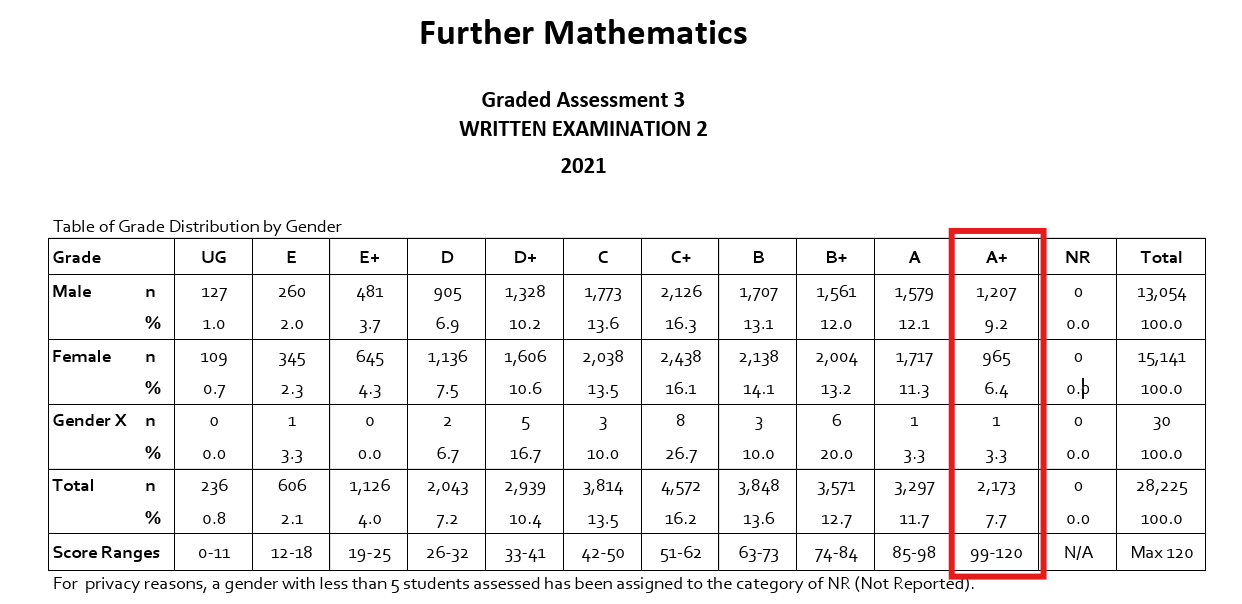
A+ STARTED AT
99 / 120 = about 82.5% of the maximum score
So that year's A+ range did not begin anywhere near 100%.
WHAT THIS DOES AND DOES NOT TELL US
It shows that an A+ does not have a universal percentage cut-off.
It does NOT tell us what the 2026 A+ boundary will be. Different study designs, papers and cohorts mean the boundary can change substantially from year to year.
THE LESSON
Walking out saying, "I lost ten marks, so an A+ is impossible" can be completely wrong. You do not need perfection. You need a strong performance on that year's paper.
NEWSLETTER | EDITION 21 · General Maths Was Supposed to Be Easy...
GENERAL MATHS: KNOWING THE BUTTONS ISN'T ENOUGH
Technology is useful. Understanding still matters.
THE CAS TRAP
Students can become very good at recognising a familiar topic, opening the right calculator page, entering numbers and producing an answer.
That can work well until the question is worded differently, requires an explanation, or expects the student to set up the mathematics independently.
FUTURE GENERAL MATHS STUDENTS SHOULD ASK
What does this quantity represent?
Why am I using this calculation?
Could I set the problem up myself?
Can I explain the answer mathematically?
Would I recognise the topic if the wording looked unfamiliar?
"EASIER THAN METHODS" DOES NOT MEAN "EASY"
General Mathematics can still reward careful interpretation, reasoning, accurate technology use and strong mathematical understanding.
Choosing it because someone described it as an 'easy 40' can create the wrong mindset from the start.
NEWSLETTER | EDITION 21 · General Maths Was Supposed to Be Easy...
METHODS: TECHNOLOGY CANNOT REPLACE FOUNDATIONS
Weak algebra eventually becomes expensive.
METHODS REQUIRES TWO DIFFERENT SKILL SETS
Students need mathematical fluency AND efficient technology use.
That means algebra, functions, calculus and probability skills still matter even when CAS is available in part of the assessment.
MATHEMATICAL FLUENCY
Algebra
Functions
Calculus
Probability
Exact values
Manipulation
TECHNOLOGY SKILLS
CAS commands
Graphing
Equation solving
Numerical methods
Checking results
Efficient workflows
THE FUTURE-STUDENT LESSON
If your algebra is weak in Year 10 or 11, do not assume the calculator will solve the problem later.
Technology can evaluate an expression. It cannot decide whether you created the right expression in the first place.
NEWSLETTER | EDITION 21 · General Maths Was Supposed to Be Easy...
THE "EASY SUBJECT" TRAP
Choose a subject for the student - not for its reputation.
STUDENTS OFTEN LABEL SUBJECTS
easy | hard | scales well | doesn't scale | easy 40 | only smart students do it
THOSE LABELS ARE NOT VERY USEFUL
A subject that feels straightforward to one student may be frustrating for another.
The better question is: What kind of mathematical thinking does this student do well - and can they sustain the practice the subject requires?
GENERAL MATHEMATICS
Interpretation, application, data, financial modelling, networks and careful technology use.
METHODS / SPECIALIST
Stronger algebraic fluency, abstraction, functions, calculus, probability and increasingly complex reasoning.
NEWSLETTER | EDITION 21 · General Maths Was Supposed to Be Easy...
FUTURE STUDENTS: WHAT SHOULD YOU DO NOW?
Years 7-11 do not need the same preparation.
YEARS 7-9 - BUILD FOUNDATIONS
Do not start VCE Maths early. Build fluency with fractions, percentages, algebra, substitution, equations, graphs, mathematical vocabulary and worded problems.
The goal is to make the basics reliable enough that harder mathematics has something solid to build on.
YEAR 10 - NOTICE HOW YOU ACTUALLY LEARN
Can you solve a question when it looks unfamiliar? Do you understand algebra or mainly copy examples? Do you rely too heavily on your calculator? Do you show enough working? Do you check whether an answer makes sense?
Use your performance and teacher advice when choosing General, Methods or Specialist.
YEAR 11 - FIND OUT WHAT IS COSTING YOU MARKS
Content knowledge? Algebra? CAS skills? Question interpretation? Timing? Careless errors? Weak working?
Different problems need different solutions. 'Do more maths' is not specific enough.
Do not expect "full-mark templates" for VCE Maths. Students should practice the mathematical ways of thinking during the practice.
NEWSLETTER | EDITION 21 · General Maths Was Supposed to Be Easy...
WHAT THE 2026 EXAMS SHOULD TEACH THE NEXT GENERATION
The answer is not to start Year 12 exams in Year 9.
1. UNDERSTANDING BEFORE PROCEDURE
Know why a method works, not only which steps to copy.
2. FOUNDATIONS BEFORE ACCELERATION
Weak algebra does not disappear because you move into a harder subject.
3. TECHNOLOGY AS A TOOL
Use CAS efficiently, but do not let it replace mathematical reasoning.
4. PRACTISE UNFAMILIAR QUESTIONS
If every practice question looks like the worked example, you may be practising recognition rather than problem solving.
5. LEARN FROM YOUR ERRORS
Identify whether the lost mark came from knowledge, application, interpretation, working, timing or a careless error.
FINAL MESSAGE
A difficult VCE examination can feel brutal for the students sitting it. For younger students, it also gives useful information.
Strong foundations, flexible thinking and genuine understanding are what make