

NEWSLETTER | EDITION 3
Which VCE English Should I Choose?
English/EAL, English Language and Literature explained
English is the only compulsory study area in VCE, but English is not just one subject. Depending on what a school offers, students may be able to choose from English/EAL, English Language and Literature.
The best choice is not simply the subject that sounds easiest, scales better, or is chosen by friends. A better question is: which English subject best suits the way the student thinks, reads, writes and communicates?
Important starting point
All three English subjects require extended writing, text analysis, engagement with ideas and consistent practice. There is no no-writing shortcut.
| Subject | Best suited to students who... | Main focus |
|---|---|---|
| English / EAL | want the broadest and most familiar option | text analysis, argument analysis and purposeful writing |
| English Language | enjoy structure, linguistics and real-world communication | how language works in everyday contexts |
| Literature | enjoy reading deeply and exploring interpretations | close reading and literary analysis |
NEWSLETTER | EDITION 3 · Which VCE English Should I Choose?
1 English / EAL
Mainstream English is the most common VCE English subject. It is usually the closest continuation from the English students have experienced in Years 7-10.
Students study texts, analyse ideas, respond to arguments, and create their own writing. The main focus is critical thinking: how texts create meaning, how writers shape ideas, and how students communicate clearly.
English suits students who are comfortable discussing themes, characters, values, author choices and arguments. It is often a good option for students who want a broad English subject that develops reading, writing, speaking and analytical skills.
| English may suit students who... | English may be challenging for students who... |
|---|---|
| enjoy discussing ideas and themes | dislike reading set texts |
| are comfortable with structured writing | tend to retell the plot rather than analyse |
| like a familiar subject style | memorise generic paragraphs |
| want a broad English pathway | avoid writing practice |
Teacher insight
English should not be seen as simply reading a book and writing an essay. Strong students answer the question directly, use evidence well, and explain their ideas clearly. Every sentence should help build the response.
NEWSLETTER | EDITION 3 · Which VCE English Should I Choose?
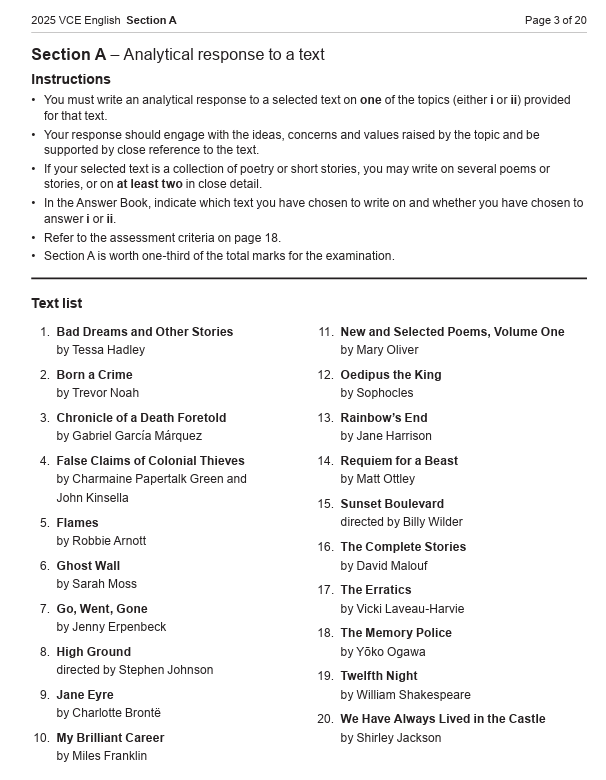
2025 VCE English Exam Section A
Text response options
This example shows how English uses studied texts as the basis for analytical responses. Students need strong text knowledge, but they also need to respond to the specific question rather than retell prepared ideas.
NEWSLETTER | EDITION 3 · Which VCE English Should I Choose?
2025 English Exam Assessment Criteria
The criteria help students see that high-scoring English is not just about long writing. Responses need knowledge, relevance, evidence, structure and control of expression.
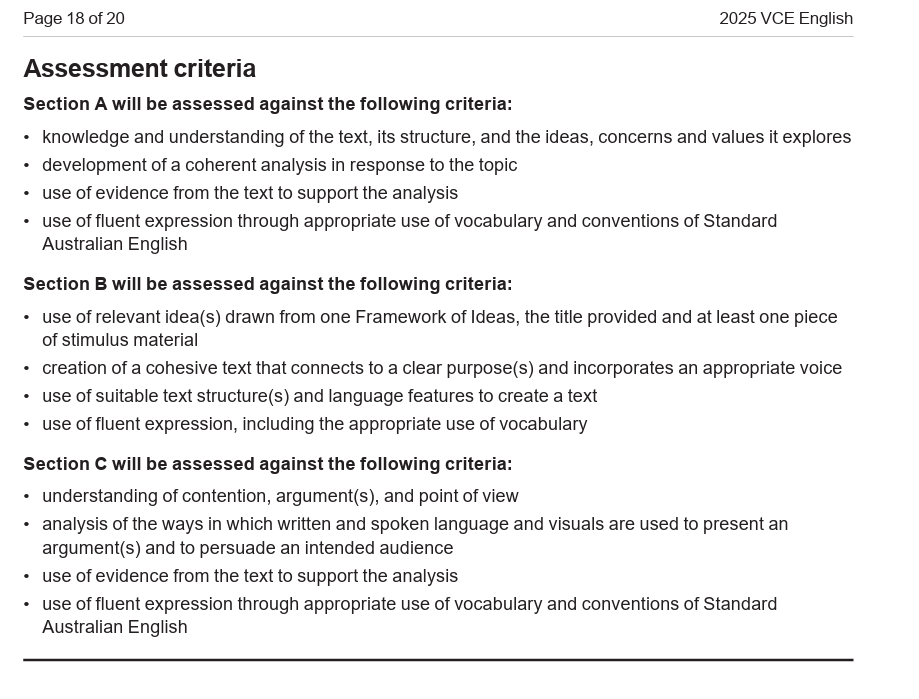
A useful preparation question is: Which part of the criteria am I improving this week - text knowledge, evidence, analysis, structure or expression?
NEWSLETTER | EDITION 3 · Which VCE English Should I Choose?
2 English Language
English Language is quite different from mainstream English. It focuses on English as a language and how language creates meaning through structure and use. In simple terms, it is closer to linguistics.
It does not centre on books in the traditional sense. Students analyse real-world language, including spoken, written, formal, informal and digital communication.
| English Language may suit students who... | English Language may be challenging for students who... |
|---|---|
| like structure and technical detail | dislike terminology |
| enjoy real-world examples | want to rely mainly on memorised essays |
| prefer analytical thinking over literary discussion | find grammar or structure frustrating |
| are interested in society and identity | prefer traditional text study |
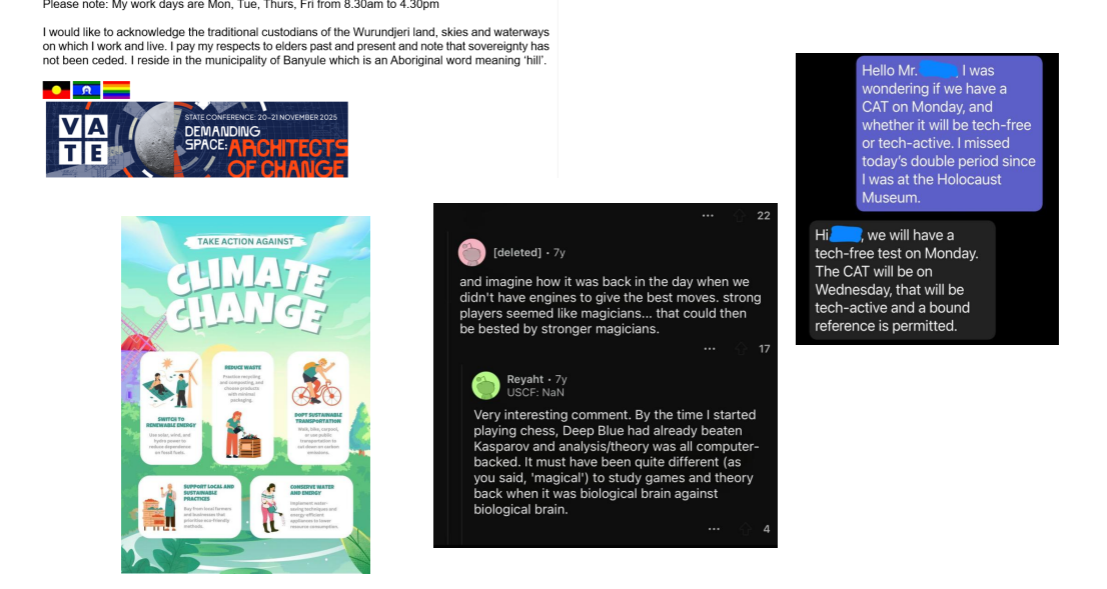
Visual example: English Language can use real-world language, not traditional set books.
NEWSLETTER | EDITION 3 · Which VCE English Should I Choose?
English language sample response
Task and source material
English Language often asks students to analyse unseen real-world language. The task is not to retell a text; students must identify language features and explain what those choices do in context.
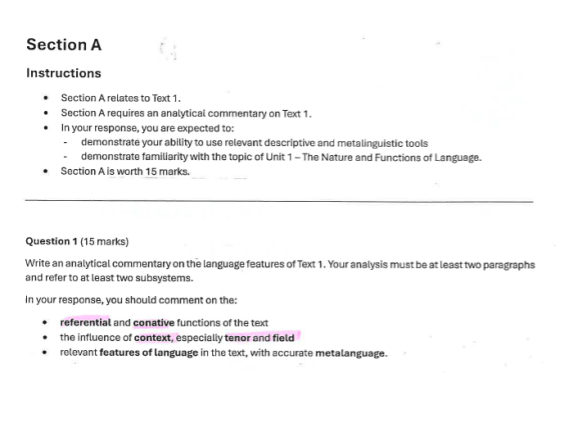
Visual example: task instructions and analytical commentary prompt.
Teacher insight
This subject can feel structured because it gives students a technical toolkit. But students still need to apply that toolkit to unfamiliar examples, not just memorise definitions.
NEWSLETTER | EDITION 3 · Which VCE English Should I Choose?
English language sample response
Analytical commentary response
The response needs metalanguage, but metalanguage alone is not enough. Students explain how language choices connect to context, audience, purpose, identity and social meaning.
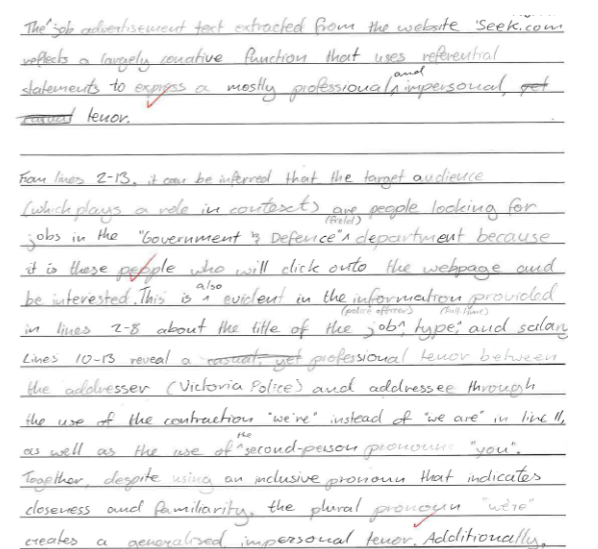
Visual example: student-style analytical commentary and teacher annotations.
A strong English Language student notices both the feature and its effect: who is using the language, why it is being used, and how it positions the audience.
NEWSLETTER | EDITION 3 · Which VCE English Should I Choose?
3 Literature
Literature is the most text-heavy of the three English subjects. It suits students who enjoy reading, close analysis and exploring different interpretations.
Literature is not simply harder English or English with more books. It has its own style and expectations. Students explore how meaning is created through language, structure, imagery, voice and form.
| Literature may suit students who... | Literature may be challenging for students who... |
|---|---|
| love reading and discussing texts | want a very formulaic subject |
| enjoy close analysis | dislike rereading |
| like open-ended interpretation | struggle with ambiguity |
| are comfortable with sophisticated writing | only enjoy casual reading |
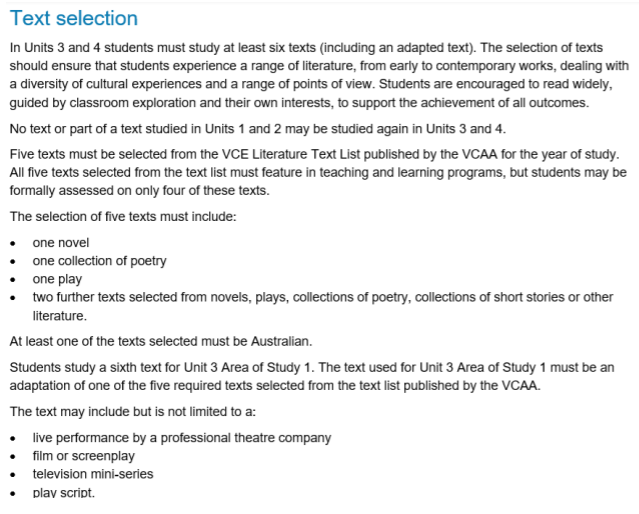
Visual example: Literature is text-heavy and requires close engagement.
NEWSLETTER | EDITION 3 · Which VCE English Should I Choose?
4 Common Questions
What are VCE English texts?
In VCE English, books usually means texts. English and Literature use set texts; English Language usually uses real-world language samples instead.
Does English Language have set books?
It has no traditional set books, but students still read closely. The reading is based on how language works in real contexts.
How should students choose?
| If a student... | They may prefer... | Possible future links |
|---|---|---|
| likes familiar essay structures and argument analysis | English / EAL | teaching, law, business, health |
| enjoys language patterns and real-world communication | English Language | linguistics, speech pathology, communications, psychology |
| loves reading, interpretation and close analysis | Literature | journalism, publishing, writing, humanities |
Can a student do more than one English?
Yes. Some students choose more than one English subject because they are strong in English or genuinely interested in more than one pathway. This can work well, but it increases workload and should not be chosen only as a panic-based backup plan. Students should check school advice and VTAC rules carefully.
What students say vs what teachers notice
| What students say | What teachers notice |
|---|---|
| English Language is better for maths/science students. | Sometimes, but only if the student enjoys technical analysis and metalanguage. |
| Literature is just for people who like reading. | Not quite. It is for students who enjoy close interpretation and rereading. |
| Mainstream English is safer. | It is familiar, but still demanding. |
| English Language has no books, so it must be easier. | It has no traditional set books, but it has technical content and unseen analysis. |
NEWSLETTER | EDITION 3 · Which VCE English Should I Choose?
Preparation Techniques
Study habits matter
Preparation technique 1
Every English subject requires effort. Writing is a skill. Students improve by practising, receiving feedback, making mistakes and refining their work over time.
Preparation technique 2
Students should also invest in their broader knowledge of the world. Reading the news, learning about history, engaging with art, music, sport, biographies, poetry and current issues can strengthen a student's ability to write with depth and nuance.
Preparation technique 3
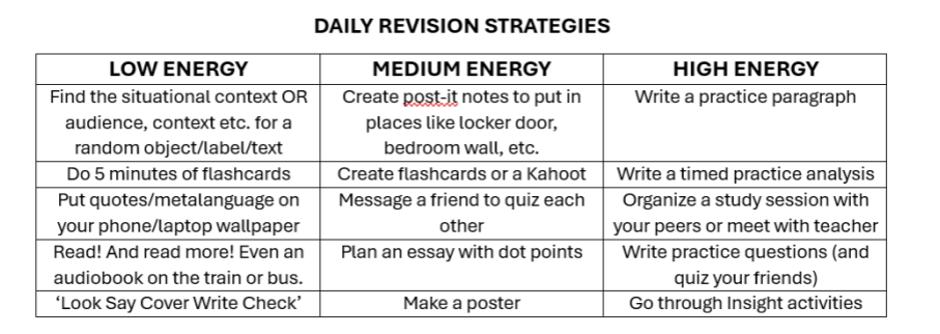
Build daily revision habits that match the student's energy level. On low-energy days, do a small task; on high-energy days, practise full writing or timed analysis.
Final advice
There is no single best English subject. There is only the best fit for the student. Choose English/EAL for the broadest and most familiar pathway, English Language for real-world communication and technical analysis, and Literature for deep reading and interpretation. The strongest choice is the one the student can sustain with regular practice.